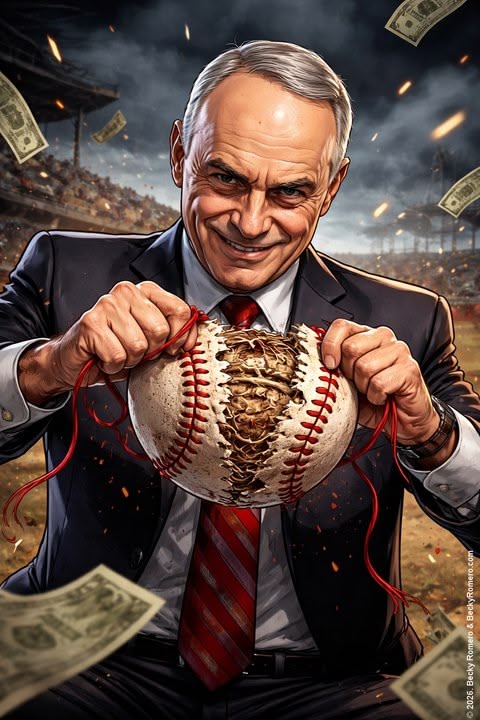
Following the Los Angeles Dodgers' 2025 NLCS win, manager Dave Roberts mockingly told critics, “They said the Dodgers are ruining baseball. Let's get four more wins and really ruin baseball,” embracing the “villain” narrative regarding their high payroll and star-studded roster. Like them or not, the Dodgers (and the Toronto Blue Jays, who are no penny-pinchers either on player salaries) provided the most exciting World Series since the Cubs won it all in 2016.
Cute. Adorable. Amateur hour. Because here’s the thing: Roberts was joking. He was leaning into a media narrative, having fun, playing along with a story. The real villain—the one who has systematically been turning America’s pastime into a corporate amusement park—is Rob Manfred.
While Roberts’ antics are temporary and playful, Manfred’s schemes are permanent and destructive. He isn’t just breaking hearts with his decisions; he’s dismantling decades of tradition, erasing rivalries, and converting a centuries-old sport into a commodity designed to fit neatly into streaming slots and Nielsen ratings. Roberts might play at villainy for a laugh; Manfred is villainy incarnate, with a pen and a rulebook instead of a grin.
Rob Manfred isn’t just a commissioner—he’s baseball’s most relentless saboteur since the Black Sox scandal, only this time the crime is against the very soul of the sport. His latest harebrained idea, ripping MLB into an East/West league structure, is less “modernizing” and more “wrecking history for TV networks.” Forget rivalries. Forget tradition. A New York Subway Series in October? Not anymore. A Freeway Series in Southern California? Not a chance. Poof.
But that's not all. Putting the Yankees in a division with Pittsburgh? My Cubbies battling for a division title with the Twins? WTF! Divisional and league rivalries built over generations are being treated like line items on a Nielsen report. Fans’ history, emotion, and pride—irrelevant. What matters is that the networks get primetime slots and everyone can watch on demand.
If that weren’t enough, Manfred has turned the postseason into a kindergarten participation ceremony. Expanded playoffs? Check. Everyone gets a ribbon. The thrill of October baseball, earned through sweat and grit, has been replaced by a buffet line of mediocre teams who “deserve” a chance to play because…well, no one likes to feel left out. And the split-season idea? Please. Fans older than me remember 1981, when the Cincinnati Reds, the team with the best record in baseball, were shut out of the playoffs because of the split-season. Yet Manfred trots this disaster out like it’s a brilliant innovation rather than a historical insult to common sense.
And let’s not forget the “zombie runner” rule, a gimmick so absurd it makes you question if he’s running a baseball league or a Halloween haunted house. Baseball’s slow, strategic grace is replaced with the chaos of a dead runner shambling onto second base like some unholy Halloween prop. And who could forget his pronouncement that the World Series trophy is just “a hunk of metal”? Really, Rob? THAT is your take on the pinnacle of achievement? The man oversees the sport’s greatest prize and reduces it to a Walmart trinket.
Manfred’s crimes aren’t just about gimmicks—they’re about loyalty to billionaire owners who would happily see the 2027 season evaporate if it padded their already obscene wallets. Threatening to cancel an entire season, putting players, fans, and the game’s integrity at risk, all in service of profit margins, is not leadership. It’s sabotage. Every decision reeks of a man who doesn’t love baseball—he loves money.
Rob Manfred’s legacy will be remembered not in wins or Hall of Famers, but in ruined rivalries, absurd gimmicks, a postseason stripped of drama, and the quiet outrage of fans who remember a time when baseball meant more than commercials and streaming packages. While the Dodgers manager jokes about "ruining baseball", Manfred grins like a villain in pinstripes, rewriting history, shuffling schedules, and turning the heartbeat of America’s pastime into a corporate cash register.
(c) 2026. Becky Romero Permission is granted to republish in full online or in print so long as a link is provided back to this page and to BeckyRomero.com
This page is a permanent link to the reply below and its nested replies. See all post replies »
Deferred salaries have been around for many decades. Even long before Bobby Bonilla Day.
As for the Dodgers, this is the first time in their history that they've won two World Series in a row.
We were the first, then Connie Mack's Athletics, the Boston Red Sox, John McGraw's Giants, then Murderers' Row, the Bronx Bombers (4 in a row), Casey's Yankees (5 in a row), Charlie Finley's A's (3 in a row), the Big Red Machine, the Yankees under Billy Martin and Bob Lemon, the Toronto Blue Jays and the Yankees (3 in a row). None of those teams "ruined baseball."
@beckyromero I’m not believing they are ruining baseball but you have to agree baseball needs a salary cap and one that factors in these deferred salaries. The small market teams have no chance to compete. These last few years the Dodgers have signed the top free agents from Ohtani to Tucker and Diaz this off season. My Mets have no chance but to pick up the left over scaps lol.
I’m not believing they are ruining baseball but you have to agree baseball needs a salary cap and one that factors in these deferred salaries.
I am absolutely AGAINST any type of salary cap, whether it be on an individual player's salary or a team cap.
I am OK with the competitive balance tax but it needs to be changed so that the teams which receive the payments MUST put that money into team salaries.
I'm not against some changes being made to deferred salaries. And let's go back to the June 15th trade deadline so that teams are less likely to tank - and if they do they'll face the wrath of their fans.
The small market teams have no chance to compete.
Best Record in MLB: 2025 NL Milwaukee Brewers 2025 AL Toronto Blue Jays / New York Yankees 2024 NL Los Angeles Dodgers 2024 AL New York Yankees 2023 NL Atlanta Braves 2023 AL Baltimore Orioles 2022 NL Los Angeles Dodgers 2022 AL Houston Astros 2021 NL San Francisco Giants 2021 AL Tampa Bay Rays
Of those 11, three would be considered small market clubs: Milwaukee, Baltimore and Tampa Bay and a fourth (San Francisco) a medium market club.
Of the 30 division winners since 2021: 2025: Milwaukee Brewers, Cleveland Guardians 2024: Milwaukee Brewers, Cleveland Guardians 2023: Milwaukee Brewers, Baltimore Orioles, Minnesota Twins 2022: Cleveland Guardians 2021: Milwaukee Brewers, Tampa Bay Rays
That's one-third of the divisions winners being in small markets.
Since 2011, World Series winners have included the Cardinals, Giants, Red Sox, Giants, Royals, Cubs, Astros, Red Sox, Nationals, Dodgers (Covid-shortened season), Braves, Astros, Rangers, Dodgers and Dodgers.
Losers in the World Series have included: Rangers, Tigers, Cardinals, Royals, Mets, Indians, Dodgers, Dodgers, Astros, Rays, Astros, Phillies, Diamondbacks, Yankees, Blue Jays
So of the 30 World Series spots in the past 15 years, 18 of the 30 franchises have participated.
How about the LCS since 2011:
Let's consider the small markets (1/3 of MLB franchises) to be: NL: Arizona, Cincinnati, Miami, Milwaukee, Pittsburgh AL: A's, Baltimore, Kansas City, Minnesota, Tampa Bay
Let's consider the medium markets (1/3 of MLB franchises) to be: NL: Colorado, St. Louis, San Diego, San Francisco, Washington AL: Chicago, Cleveland, Detroit, Seattle, Texas
Let's consider the large markets (1/3 of MLB franchises) to be: NL: Atlanta, Chicago, Los Angeles, New York, Philadelphia AL: Boston, Houston, Los Angeles, New York, Toronto
LCS Appearances: Small Markets: NL 4 AL 4 Medium Markets: NL 9 AL 8 Large Markets: NL 17 AL 18 --- Small or Medium Markets: NL 13 AL 12 Large Markets: NL 17 AL 18
However, a strong argument can be made that the reason large market teams have a disproportionate share of LCS appearances is the way the playoff structure has expanded, which virtually insures they will receive playoff spots.
Eliminate the wild card spots and here are your division winners since 2011 (league leader in wins is underlined)
2011 NL: Philadelphia , Milwaukee, Arizona 2011 AL: New York , Detroit, Texas 2012 NL: Washington, Cincinnati, San Francisco 2012 AL: New York, Detroit, Oakland 2013 NL: Atlanta, St. Louis, Los Angeles 2013 AL: Boston, Detroit, Oakland 2014 NL: Washington, St. Louis, Los Angeles 2014 AL: Baltimore, Detroit, Anaheim 2015 NL: New York, St. Louis, Los Angeles 2015 AL: Toronto, Kansas City, Texas 2016 NL: Washington, Chicago, Los Angeles 2016 AL: Boston, Cleveland, Texas 2017 NL: Washington, Chicago, Los Angeles 2017 AL: Boston, Cleveland, Houston 2018 NL: Atlanta, Milwaukee, Los Angeles 2018 AL: Boston, Cleveland, Houston 2019 NL: Atlanta, St. Louis, Los Angeles 2019 AL: New York, Minnesota, Houston 2020 NL: Atlanta, Chicago, Los Angeles 2020 AL: Tampa Bay, Minnesota, Oakland 2021 NL: Atlanta, Milwaukee, San Francisco 2021 AL:Tampa Bay, Chicago, Houston 2022 NL: Atlanta, St. Louis, Los Angeles 2022 AL: New York, Cleveland, Houston 2023 NL: Atlanta, Milwaukee, Los Angeles 2023 AL: Baltimore, Minnesota, Houston 2024 NL: Philadelphia, Milwaukee, Los Angeles 2024 AL: New York, Cleveland, Houston 2025 NL: Philadelphia, Milwaukee, Los Angeles 2025 AL: Toronto, Cleveland, Seattle
The 90 division winners since 2011: NL 9 small markets 11 medium markets 25 large markers AL 11 small markets 15 medium markets 19 large markers
Keep in mind that sometimes a league's best record may be determined by only a win or two and could easily have flipped due to unbalanced schedules.
@beckyromero you shut me up. Now what are you doing for the rest of your life? Or better yet where were you when I was single? You know your stuff. I might use you moving forward for reference.