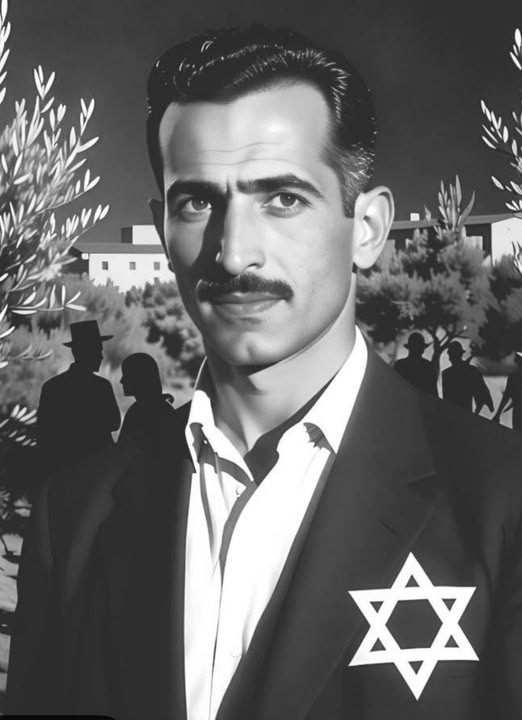
An unsung hero… Khaled Abdul-Wahab. Tunisia, 1942. The only Arab nation under direct Nazi occupation. Yellow stars forced onto chests. Synagogues ransacked. Over 5,000 Jewish men torn from their families and sent to labor camps where hundreds would die. Khaled was 31. Wealthy. Educated in New York. Spoke perfect German. The Nazi officers saw him as sophisticated, cultured—one of the "good ones." They invited him to their table. One December night in Mahdia, he sat across from drunk Wehrmacht officers. One began bragging. About a new brothel. About Jewish women dragged there by force. About the married mother he'd "chosen" for himself. He said her name out loud. Khaled knew that name. He'd known that family his entire life. He kept his face stone. Laughed at their jokes. Poured their wine. And the moment he could, he drove the officer home, then raced through blackout streets to find them. Midnight. Pounding on a door. "Pack nothing. We leave now." Twenty-five people. Three generations. Babies, grandmothers, teenagers. He loaded them into vehicles and drove 20 miles to his family's olive farm. And then the hardest part began. This wasn't one night of courage. It was 120 consecutive days of it. He hid them in his olive press. In storage sheds. In stables. He fed them when food was scarce. Kept infants quiet during patrols. Trusted servants with his life. When German soldiers came to count Jews, the families pinned on their stars and stood in formation. The moment boots left, the stars came off. One night, a drunken soldier stumbled onto the property and found them. An 11-year-old girl was hidden beneath a bed, holding her breath. She watched the soldier laugh, draw his weapon, threaten to execute everyone. Then Khaled appeared in the doorway. She would later say he looked like a guardian angel. He walked that soldier outside. Took his gun. Sent him away. Not one person on that farm died. May 1943. The British liberated Tunisia. All 25 Jews went home. Alive. Khaled returned to normal life. He married. Raised daughters. Painted. Worked quietly in government. And never spoke one word about what he'd done. Not to his wife. Not to his children. Not to historians. Not to anyone. September 4, 1997. He died at 86. His secret buried with him. Ten years later, his daughter Faiza was sitting in a Paris café reading the Sunday paper. She turned the page. An American historian was being interviewed. He was telling a story about a Tunisian Arab who hid 25 Jews from the Nazis in 1942. He was using her father's name. She was 45 years old. She had never heard this story. She read it twice, tears streaming. She tracked the historian down and asked: "Is this real?" It was real. A woman who'd hidden under that bed as a child had given 83 pages of sworn testimony before she died. Every detail confirmed. Faiza later said: "I rediscovered my father." In 2013, Khaled Abdul-Wahab was nominated for Israel's highest honor for non-Jews who saved Jewish lives during the Holocaust—Righteous Among the Nations. He would have been the first Arab ever to receive it. The committee declined. They said he hadn't risked his own life enough. Faiza's response became legendary: "My father opened his home to Jews. They did not open theirs to us." Today, the 25 people Khaled saved have hundreds of descendants living across Israel, France, America, and Tunisia. The little girl under the bed grew up, moved to Paris, married, had children and grandchildren. None of them would exist if Khaled had simply finished his dinner and stayed silent. He had everything to lose. No reason to risk it. He did it anyway. Then he carried that silence to his grave—not out of pride, but because to him, decency didn't deserve applause. The world forgot him once while he was alive. Almost forgot him again after he died. Now you know his name. If you don't tell someone, the silence wins again. Shared from Ira Jacobson via Facebook