
« Back to Album · Next »


This page is a permanent link to the comment below. See all comments »
samueltyler2 · 80-89, M
I did a little research on the subject of how police originated in the US,
https://www.nas.org/academic-questions/36/3/did-american-police-originate-from-slave-patrols
DOI: 10.51845/36.3.7
Critics of American policing often make the claim that it is a direct descendant of antebellum slave patrols, the mostly voluntary groups organized to capture runaway slaves and stifle slave rebellions in the early eighteenth century. Consider just a few examples:
“The origins of modern-day policing can be traced back to the ‘Slave Patrol.’” — NAACP1
“Policing itself started out as slave patrols. We know that.”—Rep. James Clyburn.2
“Slave patrols . . . morphed directly into police.”—Nikole Hannah-Jones.3
“[M]odernized police actually emerged in the South during slavery—they literally were slave catchers.”—Scalawag Magazine.4
Even pro-law enforcement organizations such as the National Law Enforcement Memorial and Museum in Washington, D.C. have come to accept this claim.5 According to one criminal justice textbook, it is “widely recognized that law enforcement in the 20th-century South evolved directly from these 18th- and 19th-century slave patrols.”6
While it is true that slave patrols were a form of American law enforcement that existed alongside other forms of law enforcement, the claim that American policing “traces back” to, “started out” as, or “evolved directly from,” slave patrols, or that slave patrols “morphed directly into” policing, is false. This widespread pernicious myth falsely asserts a causal relationship between slave patrols and policing and intimates that modern policing carries on a legacy of gross injustice. There is no evidence for either postulate.
In order to demonstrate causation, one must show that modern policing drew its distinctive practices and structure from slave patrols. But the evidence shows that American law enforcement—whether in the form of sheriffs, town watches, constables, or police—all emerged from distinctly English influences. Both slave patrols and modern police departments drew from these influences. The fact that the latter did so after the former does not mean that the latter emerged from the former.
https://www.nas.org/academic-questions/36/3/did-american-police-originate-from-slave-patrols
DOI: 10.51845/36.3.7
Critics of American policing often make the claim that it is a direct descendant of antebellum slave patrols, the mostly voluntary groups organized to capture runaway slaves and stifle slave rebellions in the early eighteenth century. Consider just a few examples:
“The origins of modern-day policing can be traced back to the ‘Slave Patrol.’” — NAACP1
“Policing itself started out as slave patrols. We know that.”—Rep. James Clyburn.2
“Slave patrols . . . morphed directly into police.”—Nikole Hannah-Jones.3
“[M]odernized police actually emerged in the South during slavery—they literally were slave catchers.”—Scalawag Magazine.4
Even pro-law enforcement organizations such as the National Law Enforcement Memorial and Museum in Washington, D.C. have come to accept this claim.5 According to one criminal justice textbook, it is “widely recognized that law enforcement in the 20th-century South evolved directly from these 18th- and 19th-century slave patrols.”6
While it is true that slave patrols were a form of American law enforcement that existed alongside other forms of law enforcement, the claim that American policing “traces back” to, “started out” as, or “evolved directly from,” slave patrols, or that slave patrols “morphed directly into” policing, is false. This widespread pernicious myth falsely asserts a causal relationship between slave patrols and policing and intimates that modern policing carries on a legacy of gross injustice. There is no evidence for either postulate.
In order to demonstrate causation, one must show that modern policing drew its distinctive practices and structure from slave patrols. But the evidence shows that American law enforcement—whether in the form of sheriffs, town watches, constables, or police—all emerged from distinctly English influences. Both slave patrols and modern police departments drew from these influences. The fact that the latter did so after the former does not mean that the latter emerged from the former.
FoxyGoddess · 51-55, F
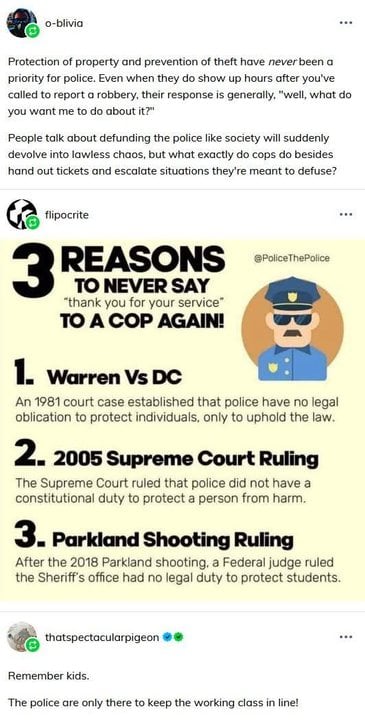
@samueltyler2 The fact still remains that the police have zero responsibility to protect people of a potential crime. They have left that up to the courts in the form of restraint orders that the police will not enforce.
In the end, the police are literally there just as a way to control people and not much else. We think they have power, but they really don't and don't want it either.
That is the point of this post.
In the end, the police are literally there just as a way to control people and not much else. We think they have power, but they really don't and don't want it either.
That is the point of this post.
samueltyler2 · 80-89, M
thanks for posting this, it raises some very interesting points. I took advantage of Google's AI capability, both to learn something about that process, but also about the issue itself. This is what Google with AI returned, very interesting if not contradictory:
Police officers have a general duty to protect life and property for the public at large, and this is a core component of their mission and job descriptions. However, in the United States, several Supreme Court cases have established that the police generally have no specific constitutional or legal duty to protect any one individual citizen from harm unless a "special relationship" is established.
General Responsibility (Policy and Mission)
Police department mission statements, professional standards (such as those from the American Bar Association), and job descriptions consistently list "protecting life and property" as a primary function and a high duty of the government and police.
Preventing Crime: They proactively patrol areas to deter crime.
Responding to Emergencies: They are expected to respond to calls for service, especially those involving immediate threats to life and property, and to assist victims.
Maintaining Order: Their actions aim to preserve public order and safety for the entire community.
Legal Duty (Court Rulings)
Despite the general mission, court rulings have refined the legal scope of this duty.
Public Duty Doctrine: The established legal principle is that law enforcement agencies owe a duty to the public at large, not to specific individuals. This means an individual generally cannot sue a police department for failing to prevent a crime that results in personal loss or harm (e.g., a burglary).
Key Supreme Court Cases:
DeShaney v. Winnebago County Dept. of Social Services (1989): The Supreme Court ruled that the Due Process Clause of the 14th Amendment does not require the state to protect the life, liberty, and property of its citizens from invasion by private actors.
Town of Castle Rock v. Gonzales (2005): The Court held that a woman with a mandatory protective order did not have a "property interest" in the order's enforcement, meaning the police were not liable for failing to arrest her estranged husband, who subsequently murdered their children.
Exceptions to the Rule ("Special Relationship")
A police officer may have a specific, legally enforceable duty to an individual under certain exceptions to the public duty doctrine:
Police officers have a general duty to protect life and property for the public at large, and this is a core component of their mission and job descriptions. However, in the United States, several Supreme Court cases have established that the police generally have no specific constitutional or legal duty to protect any one individual citizen from harm unless a "special relationship" is established.
General Responsibility (Policy and Mission)
Police department mission statements, professional standards (such as those from the American Bar Association), and job descriptions consistently list "protecting life and property" as a primary function and a high duty of the government and police.
Preventing Crime: They proactively patrol areas to deter crime.
Responding to Emergencies: They are expected to respond to calls for service, especially those involving immediate threats to life and property, and to assist victims.
Maintaining Order: Their actions aim to preserve public order and safety for the entire community.
Legal Duty (Court Rulings)
Despite the general mission, court rulings have refined the legal scope of this duty.
Public Duty Doctrine: The established legal principle is that law enforcement agencies owe a duty to the public at large, not to specific individuals. This means an individual generally cannot sue a police department for failing to prevent a crime that results in personal loss or harm (e.g., a burglary).
Key Supreme Court Cases:
DeShaney v. Winnebago County Dept. of Social Services (1989): The Supreme Court ruled that the Due Process Clause of the 14th Amendment does not require the state to protect the life, liberty, and property of its citizens from invasion by private actors.
Town of Castle Rock v. Gonzales (2005): The Court held that a woman with a mandatory protective order did not have a "property interest" in the order's enforcement, meaning the police were not liable for failing to arrest her estranged husband, who subsequently murdered their children.
Exceptions to the Rule ("Special Relationship")
A police officer may have a specific, legally enforceable duty to an individual under certain exceptions to the public duty doctrine:
Add a comment...